Why does component quality control translate into the quality of the finished piece of furniture?
The durability of a piece of furniture is no accident-it results from a well-planned process: from the selection of MDF or particleboard, through the choice of film, the lamination method, and the quality of the adhesive, all the way to the precise finishing of the edges and accurate drilling. Each of these stages influences the final result-and thus whether the finished product will meet the expectations of both the manufacturer and the user.
For a furniture manufacturer, this has very concrete operational implications. Finished components are delivered ready for immediate use, allowing the manufacturer to skip some time-consuming steps, such as cutting, edge-banding, or routing. However, if a component is manufactured outside the specified dimensional tolerances or has a shade that differs from the previous shipment, the cost savings turn into a problem: sorting, corrections, and downtime during assembly. That is why quality control on the part of the component supplier is, in practice, an integral part of the furniture manufacturer’s quality system.
Fewer complaints do not stem from a single factor-such as the adhesive alone. They result from a combination of materials, technology, process control, and precise workmanship. If the front panel or board is resistant to moisture, elevated temperatures, and daily use, and the surface is permanently bonded to the substrate, the manufacturer reduces the risk of post-sale issues.
Raw materials – the first point of quality control for furniture components
Quality control begins before any machine is started up, at the material selection stage. We work exclusively with trusted and proven suppliers, ensuring that our customers receive products that meet the highest quality standards. The wood-based panels, polymer films, and adhesives used in production come from reputable manufacturers in Poland and other European Union countries, and all raw materials comply with EU requirements, with particular emphasis on emission standards.
We treat the following two requirements as prerequisites rather than optional extras:
- reduced formaldehyde emissions – the materials used meet the requirements in force in the European Union, with particular emphasis on the new standards regarding reduced formaldehyde emissions; COMPLETE SKIN panels meet the requirements of the REACH EN717-1 lub IOSMAT181 standard regarding the reduction of formaldehyde emissions;
- Certified raw material origin – we manufacture for customers orders all furniture components using FSC®-certified raw materials, meaning they come from a certified supply chain.
The FSC® certificate is a document subject to regular external verification. For the customer, this means that the declaration of the raw material’s origin is not based solely on the supplier’s statement, but on a third-party audit that is confirmed on a regular basis. This also has commercial significance. Both Melaco and our customers export their products worldwide, and holding FSC® certification is a valuable negotiating point – and increasingly, a prerequisite for establishing business relationships.
Process parameters – what is monitored and recorded during lamination
The second area of control is the lamination process itself. In HOT MELT LAMINATION technology, a polyurethane adhesive at a specific temperature is applied to the surface of the board, and the amount of adhesive applied, the humidity, and the ambient temperature are monitored and recorded. This is no mere formality: PUR adhesives form a bond through a chemical reaction with moisture, leading to permanent cross-linking of the joint structure, so the conditions on the production line directly affect how the curing process proceeds. The adhesive weight per unit area is also controlled. The uniform application of a controlled, minimal amount of adhesive and its immediate bonding with a polymer film results in a very high-quality surface finish. The effect is evident in two ways at once.
- Technically – the adhesive bond produced in this process exhibits high resistance to moisture and elevated temperatures.
- Aesthetically – the minimal amount of joint combined with maximum bonding strength minimizes the visibility of the adhesive and results in a smooth, uniform surface without excess bonding material.
When wrapping narrow surfaces, this results in a zero-joint effect, where the seam is virtually invisible and the surfaces remain smooth and uniform. This is particularly important for premium components, as even the slightest defect in the seam would affect the product’s final aesthetic appeal. Recording parameters is what distinguishes quality control from a single visual assessment. The durability of the bond results from a combination of material, technology, and control of production parameters—and thanks to a precisely controlled PUR lamination process, it is possible to maintain high repeatability of production parameters across consecutive orders.
Dimensions and machining precision – factors that only become apparent during assembly
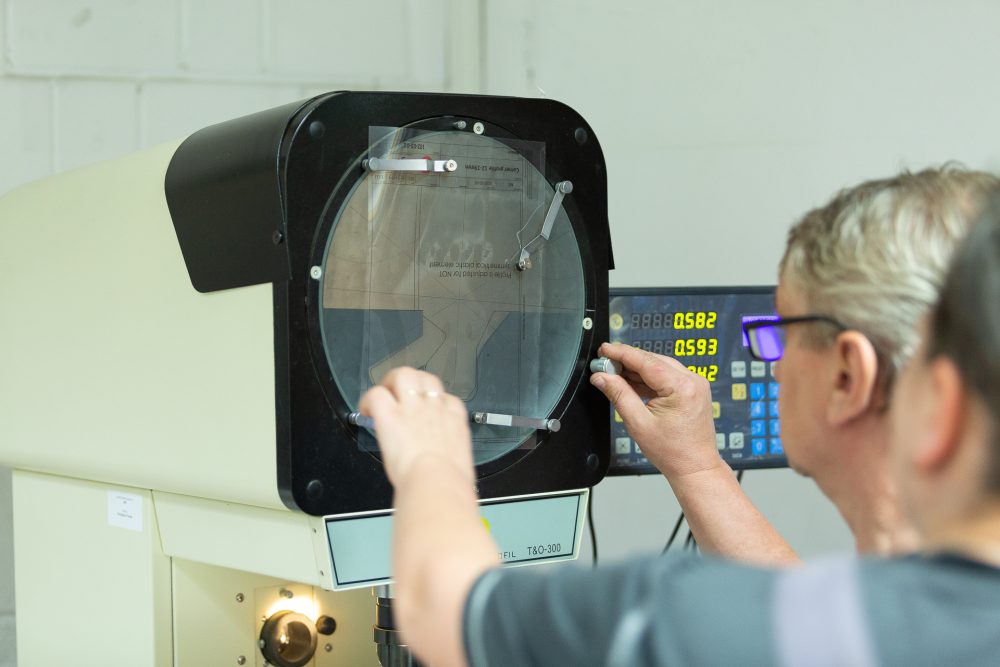
Durable bonding and a good surface finish aren’t everything. Machining precision is just as important. We can subject all manufactured furniture components to final CNC machining according to the customer’s specifications-milling, drilling, cutting, or rebating – and the resulting work is characterized by precision, repeatability, and high quality. The benchmark for quality control here is always the documentation provided by the customer, not a general standard. The result is a component ready to be integrated into the customer’s production process. Such precision has very practical significance: finished components reduce the risk of manufacturing errors, minimize material waste, and shorten production time for the furniture manufacturer.
Decor consistency and color repeatability across batches
The fourth area of quality control is visual consistency – an issue that most often becomes apparent only when adding to or expanding a collection. COMPLETE SKIN panels offer a uniform decor available across the entire product line, which eliminates the risk of color variations between individual pieces and makes it easier to create harmonious furniture sets in a single style and color. These are complemented by furniture edging strips in the same color and decor, with widths and longitudinal edge finishes tailored to the customer’s needs, ensuring that the edge finish does not clash with the surface in terms of color.
We also verify compatibility with materials the manufacturer already has in circulation. The patterns and colors of COMPLETE SKIN furniture panels are matched to laminated panels produced by well-known manufacturers such as Egger, Kronospan, Swiss Krono and Woodeco (formerly Pfleiderer). This is important because furniture manufacturers rarely source all components from a single supplier-and color variations between components from different suppliers are one of the most common causes of customer complaints.
In wood-grain patterns, there is also the issue of pattern repeatability. Unlike natural wood, cabinet fronts finished with wood-grain films guarantee consistent pattern repeat – every piece looks identical, allowing for the creation of cohesive collections across different locations and production batches.
What does component quality control offer a furniture manufacturer?
The set of control points described above translates into several specific benefits for the customer:
- predictable quality of subsequent shipments – a controlled PUR lamination process ensures high consistency in production parameters across orders;
- lower risk of complaints – a durable bond resistant to moisture and elevated temperatures minimizes problems with veneer delamination and surface warping;
- compliance with the requirements of major customers – the FSC® certification and materials with reduced formaldehyde emissions meet the requirements of retail chains and export markets;
- ready-to-install components – elements cut, veneered, and drilled according to specifications reduce waste and shorten production time;
- visual consistency of the collection – uniform decor on panels and strips, along with matching to laminated panels from well-known manufacturers, eliminate color variations between elements;
- controlled implementation – samples, prototypes, and technical documentation allow discrepancies to be identified before mass production begins.
Summary
Quality control for furniture components is not limited to a visual inspection of the finished piece. It begins with the selection of raw materials – trusted suppliers, low-formaldehyde-emission panels, and an FSC®-certified supply chain, verified by an annual audit conducted by an external entity. It includes monitoring and recording the parameters of the HOT MELT LAMINATION process: the amount of adhesive applied, air humidity, and ambient temperature, all of which determine the quality of the PUR bond. This is complemented by precise CNC machining in accordance with the customer’s specifications, along with dimensional verification and color and decor consistency checks, ensuring that subsequent batches maintain color consistency with one another. For furniture manufacturers, this means a component with predictable parameters that can be integrated into the existing production process without adjustments or sorting – and, when introducing a new product, can be evaluated in advance using a sample, prototype, and agreed-upon technical documentation. Contact us to discuss the specifications of your component, receive samples, and learn about Melaco’s technological capabilities.
Contact
Do you have questions? Contact us.
We will be pleased to answer all questions about MELACO’s offer, terms of cooperation and orders. Write or call us.
Contact
Melaco sp. z o.o.
ul. Ciepielowska 9
67-100 Nowa Sól
Poland
SALES DEPARTMENT
Agata Sroczyńska
Sales Coordinator
SALES DEPARTMENT
Beata Prałat
Sales Specialist